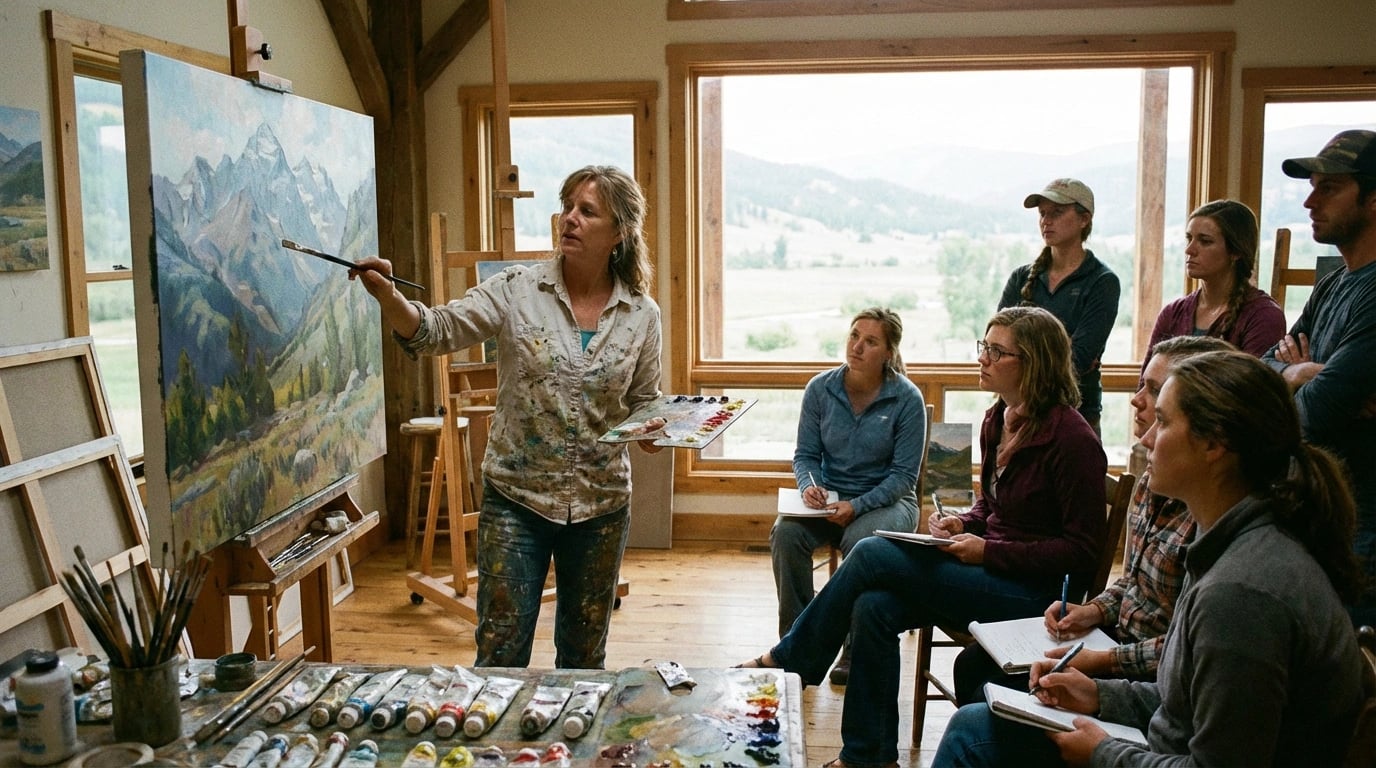
Learning how to paint landscapes can transform your artistic journey, whether you’re a complete beginner or looking to refine your existing skills. The process involves more than simply replicating what you see; it requires developing a keen understanding of composition, color theory, light, and various technical approaches. Landscape painting offers endless opportunities for creative expression, connecting you with nature while building foundational skills that apply across all artistic disciplines.
To successfully learn landscape painting, focus on mastering fundamental techniques including observational skills, color mixing, perspective understanding, and brushwork control. Start with simplified scenes using limited color palettes, gradually building complexity as your confidence grows. Regular practice sessions, studying master works, and experimenting with different mediums will accelerate your progress significantly. The key is consistent application of these core techniques rather than attempting to master everything simultaneously.
1. Develop Strong Observational Skills
The foundation of successful landscape painting lies in training your eye to truly see what’s before you rather than painting what you think you know. Spend time sketching outdoors regularly, focusing on shapes, proportions, and spatial relationships without worrying about details. This practice builds visual memory and helps you understand how elements interact within natural environments. Moreover, observational drawing strengthens your ability to simplify complex scenes into manageable compositional elements.
Start with quick gesture sketches that capture the essential character of a landscape in five to ten minutes. Additionally, practice contour drawing where you follow the edges and boundaries of forms without lifting your pencil. These exercises develop hand-eye coordination while training your brain to process visual information more effectively. Many artists find that dedicating just fifteen minutes daily to observational sketching produces remarkable improvements within weeks.
2. Master Value Relationships
Understanding value—the relative lightness or darkness of colors—is arguably more important than color accuracy in creating convincing landscapes. Before applying color, create value studies using only black, white, and grays to map out your composition’s tonal structure. This technique helps identify where focal points should fall and ensures your painting will have sufficient contrast and depth. Strong value relationships create the illusion of three-dimensional form and atmospheric space.
Practice the five-value system, which divides your scene into distinct zones: highlights, light midtones, middle values, dark midtones, and shadows. Furthermore, squinting at your reference helps eliminate distracting details while making value patterns more apparent. You can explore landscape art color palettes to understand how value interacts with color choices in professional works.
3. Understand Color Theory and Mixing
Effective color mixing distinguishes amateur work from professional paintings. Begin with a limited palette of primary colors plus white, learning to mix secondaries and tertiaries yourself rather than purchasing every premixed tube. This constraint forces you to understand color relationships, temperature, and saturation while developing mixing confidence. A typical beginner palette might include cadmium yellow, ultramarine blue, cadmium red, burnt sienna, and titanium white.
Study how colors shift based on lighting conditions and atmospheric effects. Consequently, distant objects appear cooler and less saturated due to atmospheric perspective—a phenomenon crucial for creating depth. Temperature shifts also occur throughout the day, with morning light appearing cooler and golden hour providing warm tones. The complete guide to landscape painting approaches offers additional insights into handling color variations across different times and conditions.

4. Practice Linear and Atmospheric Perspective
Creating convincing spatial depth requires understanding both linear and atmospheric perspective principles. Linear perspective involves vanishing points and convergence lines that guide how objects diminish in size as they recede. Meanwhile, atmospheric perspective addresses how clarity, color saturation, and value contrast decrease with distance. These two systems work together to create believable three-dimensional space on your two-dimensional surface.
Practice drawing simple geometric forms in perspective before tackling complex landscapes. Additionally, study how roads, rivers, and tree lines converge toward the horizon, reinforcing perspective naturally within your compositions. According to principles of graphical perspective, Renaissance artists developed these mathematical systems to achieve realistic spatial representation, techniques still fundamental to contemporary landscape art.
5. Study Composition Principles
Strong composition transforms ordinary scenes into compelling artwork by guiding viewers’ eyes through intentional design choices. The rule of thirds, leading lines, framing, and balance all contribute to creating visually engaging paintings. Rather than centering your focal point, position it along imaginary grid lines that divide your canvas into thirds both horizontally and vertically. This placement creates dynamic tension that feels more natural than symmetrical arrangements.
Experiment with different compositional formats—horizontal for expansive vistas, vertical for emphasizing height, or square for balanced scenes. Furthermore, consider how foreground, middleground, and background elements interact to create layered depth. The techniques outlined in essential landscape painting techniques demonstrate how professional artists apply compositional principles to maximize visual impact.
6. Experiment With Different Mediums
Each painting medium offers unique properties that influence your artistic expression and technical approach. Watercolors provide luminous transparency and quick drying times, making them ideal for capturing fleeting light effects outdoors. Oils offer extended working time and rich color saturation, allowing subtle blending and layering. Acrylics combine quick drying with versatility, bridging characteristics of both watercolor and oil paints.
Don’t limit yourself to traditional painting mediums either. Gouache, pastels, and mixed media approaches each present distinctive possibilities for landscape representation. Consequently, trying various mediums helps you discover which aligns best with your creative vision and working style. Many artists eventually develop proficiency across multiple mediums, selecting based on specific project requirements. If you’re interested in historical techniques, making oil paint for beginners explores traditional pigment preparation methods.
7. Analyze Works by Master Landscape Painters
Studying accomplished artists accelerates your learning by revealing how masters solved technical and creative challenges. Analyze works by painters like John Constable, J.M.W. Turner, Claude Monet, and contemporary landscape artists, noting their compositional choices, color harmonies, and brushwork techniques. Visit museums when possible, as viewing original paintings reveals texture, scale, and surface qualities that reproductions cannot capture.
Create master copies—not to plagiarize but to understand decision-making processes behind successful paintings. This practice, embraced by art students for centuries, builds technical skills while deepening appreciation for artistic choices. Additionally, reading artist biographies and viewing documentary films provides context about their working methods and philosophical approaches. Understanding landscape art movements throughout history offers perspective on how styles evolved and influenced contemporary practice. Browse our shop collection to see how different artistic approaches translate into finished works.
Learning landscape painting is a rewarding journey that combines technical skill development with creative exploration. By focusing on these seven essential techniques—observation, value, color theory, perspective, composition, medium exploration, and studying masters—you’ll build a solid foundation for continuous growth. Remember that progress comes through consistent practice rather than perfection. Set aside regular painting time, embrace mistakes as learning opportunities, and celebrate small improvements along the way. The landscapes you create will not only reflect the external world but also your unique artistic perspective and evolving technical mastery.

|
joerussell Australian abstract artists based in Byron Bay and curator of the GumPrints art print collection. |
Leave a Reply