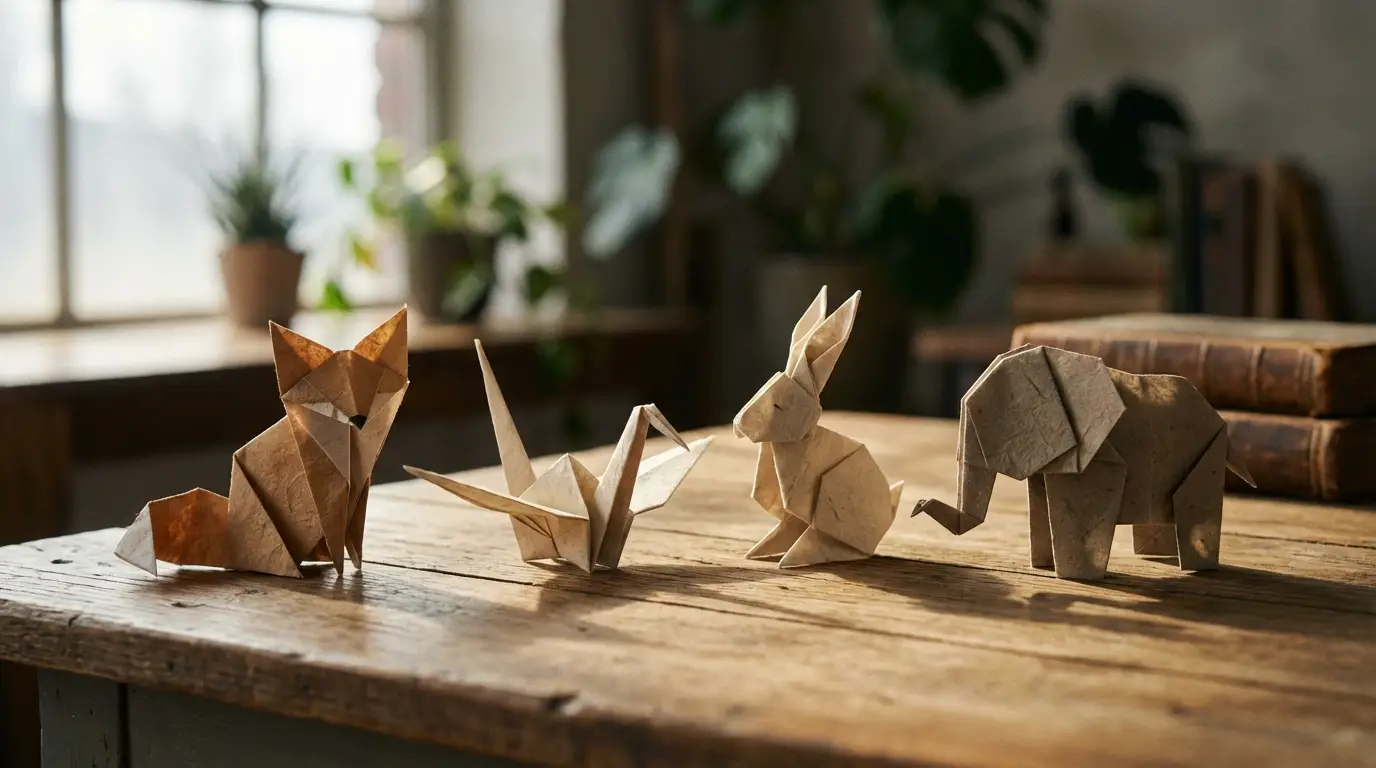
You’re halfway through folding your first origami crane when you realize your creases don’t align. The wings look lopsided. The body feels stiff. You wonder if you’re just bad at this—but here’s what every folder discovers: those mistakes aren’t personal failures. They’re predictable obstacles that every origami practitioner faces, and they’re completely solvable. Animal origami transforms a single sheet of paper into intricate sculptures through folding techniques alone, combining mathematics, geometry, and artistic expression without scissors, glue, or embellishment. The craft demands focus and patience, but it rewards you with both a meditative process and a tangible final result that actually looks like something.
Animal origami stands as one of the most popular and accessible branches of this ancient craft. From the iconic Japanese crane to elaborate insects, birds, and mammals, animal designs let you explore form and movement in paper. The emotional payoff is real—completing a paper bird that appears ready to take flight, or a delicate butterfly capturing grace in folded planes, creates something that resonates visually and symbolically in a way few other crafts do.
Understanding the Fundamentals of Paper Folding
Before diving into animal projects, you need to understand the core principles that make origami work. Paper has specific properties—thickness, grain direction, flexibility, and memory. When you fold paper repeatedly in the same spot, it begins to hold that crease naturally. This memory is fundamental to creating defined shapes and structures that hold their form without adhesive.
The key to successful origami lies in precise folding and accurate crease placement. Each fold in an animal design serves a purpose, whether creating a valley crease (folding toward you) or a mountain crease (folding away from you). Understanding the distinction between these two crease types is essential because they work together to build three-dimensional form from flat paper.
Paper selection dramatically affects your experience and results. Thin, crisp paper like kami or mulberry works best for intricate designs, while thicker paper suits larger, bolder folds. Traditional Japanese washi paper creates an authentic connection to the craft’s origins, though it’s not required. Paper folding is one of the quickest forms of art to make, yet this accessibility masks the technical skill required to execute complex designs flawlessly.
The Role of Diagramming and Instructions
Modern origami relies heavily on diagramming conventions. Standard symbols indicate valley folds, mountain folds, fold lines, existing creases, and directional arrows. Learning to read these diagrams is like learning a visual language. Most beginner designs use 10-20 steps, while advanced animal forms may require 100+ steps with multiple page-long diagrams.
Understanding proportions matters too. An animal’s head, body, and limbs need correct sizing relationships to appear recognizable. A crane with a body twice the size of its head looks awkward. The best diagrams teach you not just what to fold, but why—how the proportions create the visual identity of the animal.
Essential Techniques for Animal Origami
Animal designs rely on several recurring techniques that appear across countless projects. Mastering these foundational methods accelerates your learning and lets you tackle more ambitious designs with confidence. Each technique serves specific purposes in creating recognizable animal features.
Shaping and Sculpting Folds
Beyond the basic valley and mountain creases, animal origami employs shaping techniques that add dimension and realism. Petal folds allow you to create pointed ears or wings by folding triangular flaps upward. Sink folds tuck sections inward, useful for creating concave shapes like a bird’s chest or an animal’s face. Reverse folds rotate sections, perfect for creating beaks, tails, and limbs that extend at angles.
Squash folds open a triangular flap and flatten it symmetrically, often used when creating complex head structures or multiple layers. These folds sound technical, but they become intuitive with practice. The critical skill is understanding how each fold transitions the paper from one shape to another while maintaining structural integrity.
Creating Recognizable Features
What transforms a folded paper structure into a recognizable animal is the execution of specific features:
- Heads and faces: Narrow points fold into beaks, rounded sections suggest mammal snouts, and angular folds create insect-like features
- Wings and fins: Thin, pointed folds approximate feathers or scales; layered sections add visual complexity
- Legs and limbs: Multiple thin points require careful proportion management to avoid looking spindly or awkward
- Tails: Spiraling or curved shapes require gentle manipulation after folding to achieve the desired form
The subtle positioning of eyes—often indicated by a small crease rather than drawn details—brings remarkable life to paper animals. A crane with properly positioned head creases suddenly feels poised and alert rather than generic.
Wet-Folding and Post-Folding Shaping
Advanced folders employ wet-folding, a technique where paper is slightly dampened before folding. This allows smoother curves, more sculptural forms, and three-dimensional shaping impossible with dry folds alone. After completion, the paper dries in its molded shape, creating organic-looking results.
Even without wet-folding, gentle shaping after completing a design enhances realism. Carefully curving wings, bending legs into natural positions, and gently rounding surfaces transforms a geometric structure into something that captures movement and life.
Classic Animal Designs for Every Skill Level
The beauty of animal origami is the wide range of complexity. You can spend an afternoon creating stunning results or spend months developing mastery. Understanding which animals suit which skill levels helps you progress systematically without frustration.
Beginner-Friendly Animals
Start your journey with designs that teach fundamental techniques without overwhelming complexity. The traditional crane requires only 8-10 steps and teaches valley folds, reverse folds, and symmetry principles. The flapping bird (where pulling a hidden tab makes wings move) is equally simple yet produces immediate, satisfying motion.
Jumping frogs teach squash and petal folds while delivering playful functionality—you can actually make them jump. Simple butterflies, paper airplanes disguised as birds, and basic fish all serve as excellent gateways. These projects typically use single-sheet designs and take 10-30 minutes to complete, making them perfect for building confidence.
Intermediate Designs
Once fundamentals click, intermediate animals like flapping dragons, lifelike butterflies, and geometric animals challenge you with 30-50 step instructions and multiple folding sequences. These designs often require better spatial reasoning and careful attention to crease precision.
Jumping rabbits, origami dinosaurs, and simple insects fall into this category. The traditional jumping grasshopper is deceptively complex but rewards meticulous folding with exceptional function. At this level, you’re learning that small deviations in crease placement compound into larger inaccuracies in the final form.
Advanced and Complex Animals
Advanced animal designs represent serious challenges requiring 100+ steps, expert-level crease precision, and often 2-4 hours of focused folding. Realistic insects like praying mantis or stag beetle designs demonstrate incredible anatomical accuracy. Complex mammals—horses, dogs, bears with individualized features—require sophisticated multi-sheet or advanced shaping techniques.
Some of the most celebrated modern origami artists create animals so realistic they appear almost lifelike despite being pure folded paper. These masterpieces often combine mathematical precision with artistic sensibility, representing years of development and refinement by their creators.
Advanced Projects and Complex Structures
Once you’ve mastered fundamental techniques, advanced origami opens possibilities that border on sculptural art. These projects demand not just technical skill but also intuitive understanding of how paper behaves under extreme manipulation.
Multi-Piece Animals and Assemblies
Rather than folding an entire animal from a single sheet, advanced folders create separate components—head, body, legs, wings—then assemble them. This modular approach allows incredible detail and realistic proportions impossible with single-sheet designs. You might fold eight individual legs for a spider, each with distinct jointing and positioning.
Modular origami also enables larger-scale sculptures. A paper dragon assembled from 100+ individual folded modules becomes a genuine installation piece. Understanding the elements of great art—composition, balance, proportion—applies as much to origami as to traditional mediums.
Realistic Detail and Characterization
Advanced animal folders push realism by incorporating subtle details: individual feather representations, accurate musculature hints, and expressive posing. A paper lion doesn’t just look like a lion; it captures a specific attitude—prowling, resting, or alert. This requires understanding animal anatomy and movement, then translating that knowledge into fold sequences.
Some artists create series exploring animals in different poses or emotional states. A paper bird might be depicted taking off, perched, or in mid-flight—each requiring entirely different fold sequences and compositional approaches.
Common Challenges and How to Overcome Them
Every folder encounters predictable obstacles. Understanding these challenges and their solutions accelerates your progress and prevents frustration from derailing your practice.
Crease Accuracy and Precision
The most common struggle for beginners is maintaining crease accuracy. Slight deviations accumulate across multiple folds, resulting in a final animal that looks somewhat off. Prevention is simpler than correction: use a bone folder (a smooth tool that creates clean, defined creases), take time to align corners precisely before committing to a fold, and gently crease new folds rather than aggressively flattening them.
Learning to feel when a crease is “right” matters more than endless precision. Your fingers develop sensitivity to proper alignment through repetition. Some folds need sharp creases, while others work better slightly softer. This tactile awareness develops naturally as you practice intentionally.
Paper Selection and Handling
Wrong paper choice causes more failures than any other factor. Paper that’s too thick becomes bulky and difficult to fold; paper that’s too thin tears at valley intersections. Humidity affects paper memory—very dry air makes paper brittle, while high humidity makes it limp. Store paper in a cool, dry place and fold when humidity levels are moderate.
Quality paper isn’t always expensive. A ream of inexpensive origami paper serves practice; save premium Japanese papers for finished pieces worthy of display. As you advance, experimenting with textured papers, colored sheets, and specialty materials becomes part of the creative journey.
Understanding Three-Dimensional Progression
Visualizing how flat-paper folds translate into three-dimensional form challenges many beginners. Following diagrams step-by-step without understanding the spatial logic creates confusion when something looks wrong. Study several completed examples of the same design before starting. Watch video tutorials that show the three-dimensional progression in real-time.
Experienced folders mentally rotate the model constantly, understanding how each fold contributes to the emerging form. This spatial reasoning improves dramatically with practice—after completing 20 animals, three-dimensional visualization becomes almost automatic.
| Challenge | Root Cause | Solution |
|---|---|---|
| Creases don’t align properly | Rushing folds or imprecise corner positioning | Slow down, use a bone folder, align corners before folding |
| Final animal looks distorted | Small early errors compound through multiple steps | Double-check each step against diagram before proceeding |
| Paper tears at fold intersections | Paper too thin or creases too sharp | Upgrade to quality origami paper, fold more gently |
| Can’t visualize 3D progression | Diagram reading skills underdeveloped | Watch video tutorials, study completed examples first |
| Folds feel stiff or rigid | Over-creasing or using paper with poor memory | Try different paper type, crease more softly |
Building Your Origami Practice
Consistent practice transforms casual interest into genuine skill. Unlike many pursuits where progress depends on expensive equipment or access, origami requires only paper, patience, and intention. Building a sustainable practice that sustains motivation through inevitable plateaus matters more than raw hours spent folding.
Structured Learning Pathways
Start by choosing a learning approach that matches your style. Some folders thrive with physical instruction books showing step-by-step diagrams. Others prefer video tutorials where they watch completed demonstrations before attempting the design themselves. Many successful folders combine both—reading diagrams while referencing video walkthroughs for clarification on tricky sequences.
Follow progression systematically. Complete at least three designs at each difficulty level before advancing. This ensures you internalize techniques rather than merely executing individual projects. A common mistake is jumping to advanced designs before mastering intermediate fundamentals, leading to frustration when things don’t work as expected.
Creating a Dedicated Space
Designate a specific folding area with proper lighting, a flat work surface, and your materials organized and accessible. This doesn’t require much space—a corner of a desk suffices. Having everything ready removes friction when you want to fold. Store completed animals safely to preserve them; a dedicated shelf or display case protects your creations while reminding you of your progress.
Proper lighting is underestimated. Poor lighting leads to eye strain, difficulty seeing fold lines clearly, and mistakes from misreading diagram details. A desk lamp or natural window light makes the difference between enjoyable sessions and frustrating ones.
Tracking Progress and Celebrating Milestones
Keep records of animals you’ve completed, noting the date, paper type, difficulty level, and any challenges overcome. This creates accountability and reveals patterns in your learning journey. Looking back at your first crane compared to your 50th demonstrates tangible improvement that sustains motivation during difficult projects.
Share your work with others. Photography transforms a private hobby into something shareable. Displaying your origami creations properly elevates them from temporary paper experiments to celebrated art pieces. The origami community online is remarkably supportive—sharing photos often brings encouragement and constructive feedback that accelerates improvement.
Connecting with the Broader Origami Community
The global origami community thrives both online and in person. Origami (Wikipedia) documents the rich history and diverse practitioners of this craft worldwide. Online forums, Reddit communities, and social media groups connect folders across continents, sharing discoveries, challenging each other with complex designs, and celebrating the intersection of mathematics, art, and craft.
Attending origami conventions or workshops, if available in your region, accelerates learning exponentially. Meeting experienced folders, watching demonstrations in person, and getting hands-on guidance creates breakthroughs impossible through self-study alone. The investment in travel or workshop fees returns manifold in skill development and community connection.
Your next step is simple: buy quality origami paper, choose one beginner design, and commit to completing it without skipping steps. Don’t aim for perfection—aim for completion. Your first crane won’t be flawless, but it will teach you more than any article can. Every origami master started with a single wobbly fold and a willingness to try again.

|
Joseph Russell Australian abstract artist based in Byron Bay and curator of the GumPrints art print collection. |
Leave a Reply