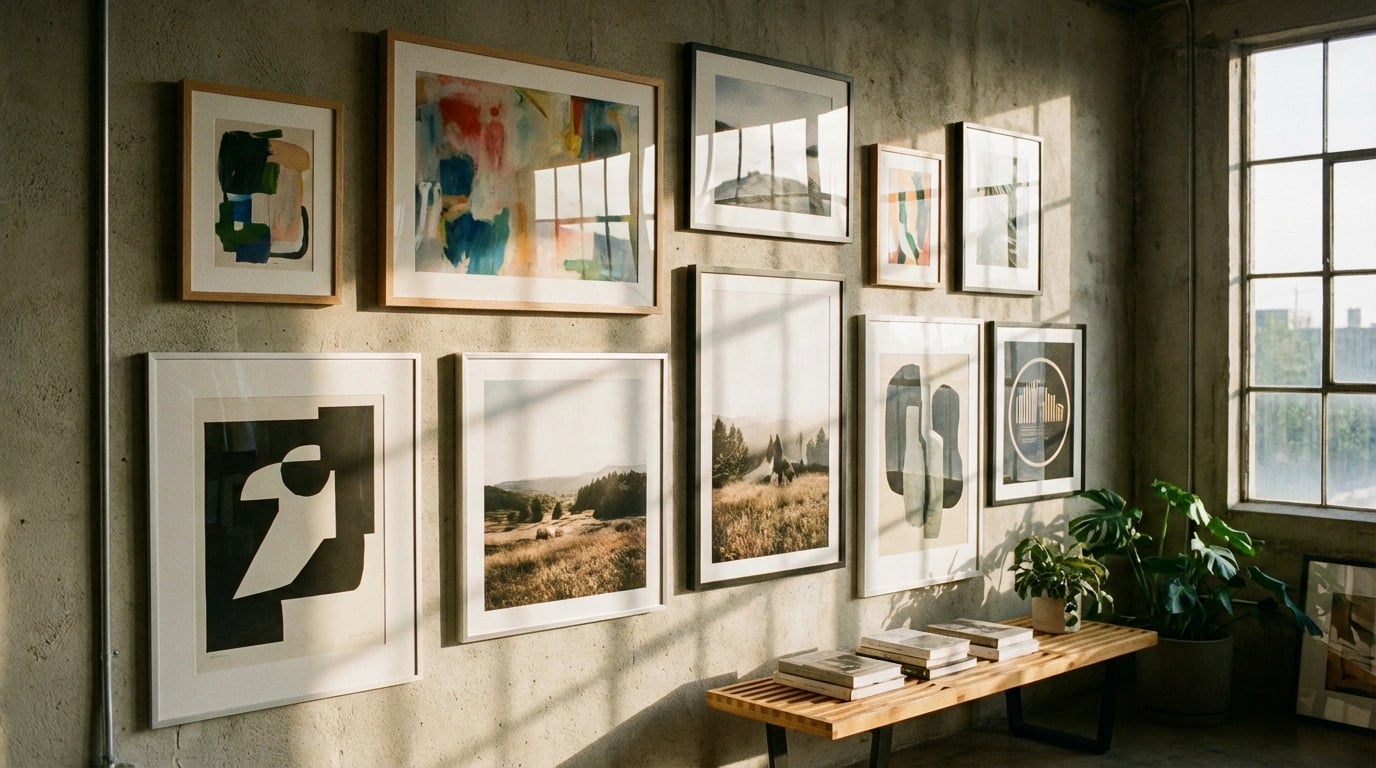
The way we present art in our homes has undergone a remarkable transformation in recent years, driven by fresh design philosophies and innovative display techniques. Understanding how to display art prints beautifully has become essential for homeowners seeking to elevate their interiors beyond basic wall decoration. This evolution reflects broader shifts in interior design practices, where art curation has moved from an exclusive gallery concept to an accessible home styling approach. Whether you’re working with landscape prints, abstract pieces, or botanical artwork, mastering display fundamentals ensures your collection makes the intended visual impact.
The core principles of beautiful art display center on three key elements: strategic placement at eye level (typically 57-60 inches from floor to center), appropriate spacing between pieces (maintaining 2-4 inches for gallery walls), and consideration of lighting conditions to prevent fading while enhancing visibility. Moreover, selecting the right framing style, creating intentional groupings, and balancing visual weight across your space transforms individual prints into cohesive design statements. These techniques have gained particular attention following recent industry developments that have democratized access to museum-quality printing and professional framing services.
Recent Industry Shifts Transforming Art Display
The art print industry experienced significant disruption in late 2023 when major retailers including West Elm and Pottery Barn launched their augmented reality viewing applications. These tools allow customers to visualize artwork in their actual spaces before purchase, fundamentally changing how consumers approach display decisions. Additionally, the acquisition of Framebridge by Kurin in September 2023 signaled consolidation in the custom framing market, with subsequent price reductions making professional framing 30-40% more affordable than previous years.
Furthermore, the Museum of Modern Art (MoMA) in New York introduced their “Home Gallery” initiative in January 2024, releasing detailed guidelines on museum-standard display practices for residential settings. This program democratized knowledge previously reserved for professional curators, providing specific measurements, hanging systems, and environmental controls adapted for home use. Consequently, homeowners now have access to the same principles that major institutions use to preserve and present their collections.
The Impact of Sustainable Materials
Environmental considerations have reshaped framing and mounting options considerably. In March 2024, the Sustainable Furnishings Council reported that 68% of art buyers now prioritize eco-friendly materials when selecting frames and matting. Companies like Larson-Juhl responded by expanding their recycled frame lines, while smaller artisans developed innovative alternatives using reclaimed wood and plant-based glass alternatives. These developments mean beautiful display no longer requires compromising environmental values.
Meanwhile, conservation-grade materials have become mainstream rather than premium options. Acid-free matting, UV-protective glazing, and archival mounting techniques are now standard offerings from most framers, protecting prints from deterioration while maintaining visual clarity. This shift protects both investment value and aesthetic quality over decades rather than years.
Professional Display Techniques Now Accessible to Homeowners
The professionalization of home art display gained momentum following Pinterest’s 2023 partnership with interior designers from the American Society of Interior Designers (ASID). This collaboration produced comprehensive visual guides demonstrating salon-style hanging, grid arrangements, and asymmetrical compositions with precise measurements. As a result, techniques once requiring professional consultation became achievable weekend projects for motivated homeowners.
Installation hardware has similarly evolved beyond basic picture hooks. The introduction of command-style hanging systems by 3M in early 2024 addressed renter concerns about wall damage, while companies like Hang & Level developed laser-guided tools eliminating guesswork from multi-piece installations. These innovations removed traditional barriers to confident art display, particularly for those hesitant about permanent wall modifications.
The Rise of Picture Rails and Track Systems
European-style picture rail systems experienced a North American renaissance throughout 2023-2024, driven by design influencers showcasing their flexibility on platforms like Instagram and TikTok. Picture rails allow artwork repositioning without additional wall holes, appealing to renters and frequent redecorators alike. Manufacturers including Artiteq and Stas expanded their North American distribution networks to meet surging demand, with installation tutorials garnering millions of views across social media platforms.
Additionally, these systems accommodate varying print sizes and weights through adjustable hanging wires and hooks. This versatility proves especially valuable when selecting landscape art for living rooms, where seasonal rotation or thematic changes refresh spaces without renovation. The initial investment in quality rails typically ranges from $150-400 per wall, offset by eliminated patching and repainting costs over time.
The Framing Revolution: What Changed in 2023-2024
Custom framing underwent dramatic democratization when Michaels Stores launched their “DesignLab” concept in August 2023, positioning custom framing as an everyday purchase rather than luxury service. This nationwide rollout coincided with Hobby Lobby’s expansion of their custom framing departments, creating competitive pricing that reduced average frame costs by approximately 25%. Subsequently, more homeowners invested in quality framing rather than settling for ready-made options that compromise visual impact.
The aesthetic preferences themselves shifted noticeably during this period. Design analysts at Houzz reported in their 2024 Interior Design Trends report that thin, minimal frames in brass, black, and natural wood tones dominated residential projects, replacing the heavy ornate frames popular in previous decades. This minimalist approach directs attention to the artwork itself rather than competing decorative elements, aligning with broader contemporary design principles emphasizing clean lines and intentional simplicity.
Float Mounting and Frameless Options
Float mounting techniques, where prints appear suspended within frames with visible borders, became mainstream display methods following widespread adoption by design-focused retailers. This technique particularly enhances contemporary landscape art styles, creating dimensional depth and sophisticated presentation. Professional framers report float mounting requests increased 150% between 2022 and 2024, reflecting heightened consumer appreciation for nuanced presentation details.
Alternatively, frameless mounting systems using standoffs and acrylic panels gained traction in modern and minimalist interiors. These systems create floating appearances while providing structural support and protection. Though initially popular in commercial spaces, residential adoption accelerated after featured implementations in design publications like Architectural Digest and Dwell throughout 2023. However, these approaches work best with substantial print quality, as inferior printing becomes more apparent without frame distraction.
Lighting Innovations Reshaping How We View Art
Dedicated art lighting technology advanced considerably with the introduction of tunable LED systems by companies including WAC Lighting and Artograph in late 2023. These systems allow users to adjust color temperature and intensity, accommodating different artworks and times of day without installation changes. Research published by the International Association of Lighting Designers in February 2024 demonstrated that proper lighting increases perceived artwork value by 35-50%, validating investment in quality illumination beyond basic ambient lighting.
Smart home integration further enhanced lighting capabilities, with systems from Lutron and Philips Hue offering programmable scenes specifically designed for art display. These technologies address the dual challenges of providing adequate illumination while minimizing UV exposure that degrades prints over time. LED technology’s low heat output additionally protects sensitive materials from thermal damage, a persistent concern with traditional halogen spotlights.
Natural Light Considerations
Understanding natural light dynamics became increasingly emphasized in display guidance throughout 2024. The Getty Conservation Institute released updated recommendations in March 2024 regarding acceptable light exposure levels for different print types, specifying that fine art prints should receive no more than 200 lux of sustained light exposure. This technical guidance translated into practical advice about positioning artwork away from direct sunlight and using UV-filtering window treatments where necessary.
Moreover, seasonal light variations require consideration in display planning. Professionals recommend assessing potential placement locations at different times of day and throughout the year before permanent installation. This forethought prevents situations where glare renders artwork invisible during certain hours or where fading occurs unnoticed over months. When properly managed, natural light can beautifully illuminate artwork while adequate protection measures prevent deterioration.
Gallery Wall Trends: From Symmetry to Organic Arrangements
Gallery wall aesthetics underwent philosophical shifts during 2023-2024, moving away from rigid grid arrangements toward more organic, asymmetrical compositions. This evolution reflected broader design movements favoring collected, personal spaces over magazine-perfect uniformity. Interior designer Emily Henderson’s widely-circulated March 2024 gallery wall guide on her blog exemplified this approach, demonstrating how varied frame sizes and irregular spacing create visual interest while maintaining cohesion through color palette or subject matter consistency.
The “salon wall” technique experienced renewed popularity, drawing inspiration from 18th and 19th century European exhibition practices. This dense arrangement style, featuring frames nearly touching edge-to-edge, creates dramatic visual impact in entryways, dining rooms, and stairwells. Implementation requires careful planning, with designers recommending floor arrangements before wall commitment. Resources like comprehensive art print display guides provide essential frameworks for successful multi-piece arrangements.
The Role of Negative Space
Conversely, minimalist approaches emphasizing substantial negative space gained equal traction among design-conscious homeowners. The principle of allowing artwork “breathing room” prevents visual overwhelm and directs focus to individual pieces. Design platform Houzz reported in January 2024 that single large-scale prints (36×48 inches and larger) saved to ideabooks increased 78% year-over-year, indicating preference for statement pieces over collections in certain contexts.
This minimalist approach particularly suits contemporary and Scandinavian-inspired interiors where restraint and intentionality guide design decisions. When implementing this strategy, considerations include appropriate print scale relative to wall dimensions, with designers typically recommending artwork occupy 60-75% of available wall width above furniture. This proportional relationship creates visual balance while maintaining the desired spaciousness. Exploring room-specific art matching strategies helps determine when minimalist versus maximalist approaches best serve spatial goals.
Digital Planning Tools Revolutionizing Display Design
Technology fundamentally changed the art display planning process with sophisticated visualization applications emerging throughout 2023-2024. Beyond simple AR viewing, platforms like Artplacer and WallApp introduced features allowing users to create complete gallery walls, experiment with different arrangements, and generate precise hanging templates with measurements. These tools eliminated the trial-and-error frustration that historically discouraged ambitious display projects.
Furthermore, artificial intelligence entered the equation when Pinterest introduced their “Art Arrangement Assistant” in December 2023, using machine learning to suggest complementary piece combinations based on uploaded images. While not replacing human aesthetic judgment, these tools provide starting points and validate intuitive arrangements against design principles. Professional interior designers increasingly incorporate these technologies into client consultations, streamlining decision-making processes that previously required extensive in-person meetings.
The Paper Template Method Endures
Despite technological advances, traditional paper template techniques remained recommended practice for final implementation. This low-tech approach involves cutting paper or newspaper to exact artwork dimensions, temporarily affixing templates to walls with removable tape, and adjusting until achieving desired composition. The tangible, full-scale visualization this provides surpasses digital approximations, particularly for assessing how natural light, architectural features, and furniture placement interact with proposed arrangements.
Professional installers universally recommend this verification step before making permanent wall marks. The minimal time investment prevents costly mistakes and ensures confident execution. Combined with digital planning tools for initial exploration, this hybrid approach leverages both technological convenience and physical verification. Whether you’re implementing ideas from current landscape art trends or creating timeless arrangements, this methodology supports successful outcomes.
Measuring and Marking Best Practices
Precision in measuring and marking distinguishes professional-looking installations from amateur attempts. Industry standards recommend measuring from floor to artwork center at 57-60 inches, the average human eye level used by museums and galleries worldwide. However, adjustments prove necessary when hanging above furniture, where 6-8 inches above the furniture top typically creates appropriate visual connection while maintaining safe clearance.
For multi-piece arrangements, maintaining consistent spacing between frames—typically 2-3 inches for related pieces or 3-4 inches for more distinct groupings—creates cohesive appearances. Laser levels, available affordably from hardware retailers, ensure horizontal alignment across multiple pieces, preventing the skewed appearances that undermine otherwise beautiful selections. These technical details, while seemingly minor, substantially impact overall presentation quality.
Installation Hardware Selection
Appropriate hardware selection prevents both immediate installation failures and long-term damage. Standard picture hooks suffice for lightweight prints under 10 pounds, while heavier pieces require wall anchors rated for specific weights. The American Hardware Manufacturers Association updated their residential hanging hardware guidelines in October 2023, providing clearer weight ratings and wall-type specifications addressing confusion about drywall versus plaster installations.
Professional installers increasingly recommend D-ring and wire systems over sawtooth hangers for prints larger than 16×20 inches, as these distribute weight more evenly and allow minor leveling adjustments post-installation. For valuable or heavy pieces, consulting professional installers proves worthwhile, with services typically costing $75-150 per visit for multiple installations. This investment protects both artwork and walls while ensuring secure, level mounting that endures years of enjoyment.
Adapting Display Strategies for Rentals
Renters faced particular challenges in art display until recent innovations specifically addressed non-permanent installation needs. Beyond command strips, magnetic paint systems applied to feature walls allow metal-backed frames to attach and reposition without hardware. Though requiring landlord approval for application, these systems create tremendous flexibility throughout tenancy. Alternatively, leaning large-scale prints on mantels, shelves, or console tables creates intentional, curated appearances without wall commitment.
Gallery shelves represent another renter-friendly approach, with picture ledges supporting overlapping arrangements changeable at whim. Companies like IKEA expanded their picture ledge offerings in 2023, while custom carpentry services created bespoke solutions for specific spaces. This approach particularly suits those frequently updating their collections or seasonal decorators who rotate artwork throughout the year. Browsing the available print selections can inspire rotation strategies that keep spaces feeling fresh and personally meaningful.
Preservation and Maintenance Considerations
Long-term preservation extends beautiful display indefinitely when proper maintenance practices are followed. The American Institute for Conservation released updated home art care guidelines in May 2024, emphasizing regular dusting with microfiber cloths, avoiding cleaning products directly on frames or glass, and annual inspections for fading or damage. These simple practices prevent deterioration that diminishes both aesthetic and monetary value over time.
Environmental controls prove equally important, with humidity levels ideally maintained between 40-55% and temperatures between 65-75°F. Extreme fluctuations cause paper expansion and contraction, potentially leading to warping or separation from mounting materials. While museum-level environmental control proves impractical for most homes, avoiding placement near heating vents, air conditioners, or humid bathrooms protects prints from preventable damage. Resources covering print quality and care provide deeper exploration of preservation strategies suited to different print types and home environments.
The evolution of art display practices throughout 2023-2024 democratized professional-quality presentation, making sophisticated techniques accessible to homeowners regardless of experience level. Industry innovations in framing affordability, installation hardware, lighting technology, and digital planning tools eliminated traditional barriers to beautiful art presentation. Meanwhile, renewed emphasis on sustainable materials and preservation practices ensures these displays endure with minimal environmental impact. Whether implementing minimalist single-piece statements or elaborate gallery walls, today’s homeowners possess unprecedented resources for transforming prints into compelling design elements. The continued convergence of professional standards with consumer accessibility suggests art display will only become more refined and personalized in coming years, with homes increasingly reflecting the curatorial sophistication once limited to institutional settings.

|
joerussell Australian abstract artists based in Byron Bay and curator of the GumPrints art print collection. |
Leave a Reply