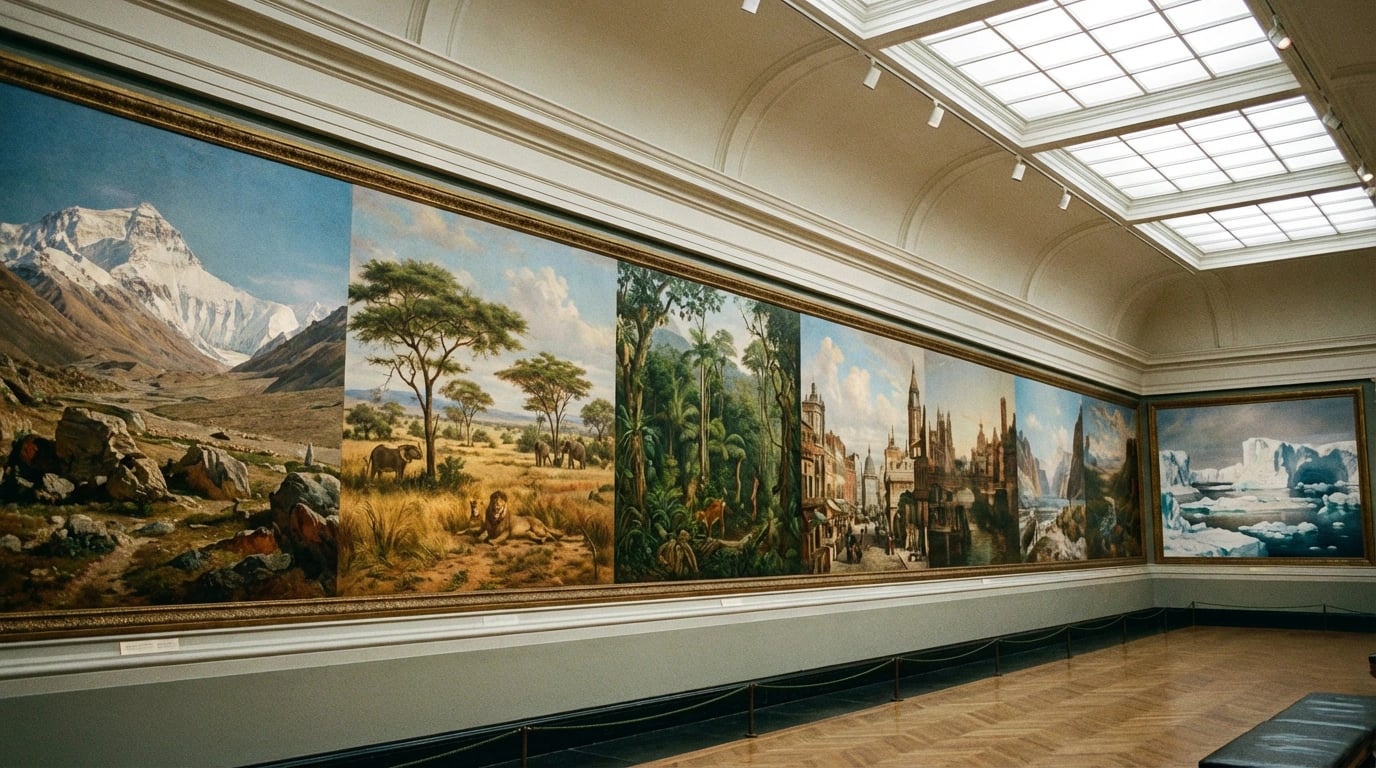
When we examine landscape art across continents and cultures, one truth becomes increasingly clear: the Western tradition has dominated our understanding of this genre for far too long. From museum walls to art education curricula, European and American landscape movements receive disproportionate attention while equally sophisticated traditions from Asia, Africa, and indigenous cultures remain marginalized. This imbalance not only distorts art history but also limits our appreciation of how diverse cultures interpret and represent their natural environments.
The conventional narrative positions landscape painting as a primarily European invention, celebrating the Dutch Golden Age, English Romanticism, and American Hudson River School as defining moments. However, this perspective ignores millennia of sophisticated landscape traditions worldwide. Chinese shan shui painting emerged over a thousand years before European landscape art gained prominence, developing complex philosophical frameworks for depicting mountains and water. Japanese ukiyo-e woodblock prints revolutionized spatial composition centuries before Western modernism. Aboriginal Australian art has represented land relationships for over 60,000 years through deeply symbolic visual languages. These aren’t merely “alternative” approaches—they represent foundational contributions that deserve equal recognition in any comprehensive discussion of landscape art.
Eastern Traditions Deserve Equal Footing
Chinese landscape painting, particularly the shan shui tradition, developed sophisticated aesthetic philosophies that fundamentally differ from Western approaches. Rather than pursuing realistic representation, these works embodied Taoist and Buddhist principles, viewing landscape as a meditation on cosmic harmony. The emphasis on negative space, atmospheric perspective, and the relationship between humans and nature offers profound insights that Western traditions often overlook.
Similarly, Persian miniature paintings integrated landscapes with narrative elements in ways that challenge Western distinctions between landscape and figurative art. Indian Pahari paintings depicted mountainous regions through vibrant color palettes and stylized forms that captured emotional and spiritual dimensions of place. These approaches demonstrate that realism—so prized in Western art history—represents merely one valid method among many for engaging with natural environments.
Technical Innovation Beyond European Borders
Moreover, technical innovations flourished outside Europe long before the Renaissance. Japanese artists mastered woodblock printing techniques that enabled unprecedented color gradations and atmospheric effects. Korean celadon glazes captured landscape elements with subtlety unmatched in contemporary European ceramics. These achievements challenge the notion that Western art history represents a linear progression toward technical mastery. Instead, they reveal parallel developments of equal sophistication across cultures.
Colonial Perspectives Still Shape Contemporary Views
The way we currently categorize and value landscape art reflects colonial power structures that persist in art institutions worldwide. European colonizers often dismissed indigenous landscape representations as “primitive” or “decorative” rather than recognizing them as sophisticated visual languages. Consequently, museums continue to display Aboriginal Australian dot paintings in anthropology sections rather than alongside European masters, implicitly positioning them as cultural artifacts rather than fine art.
This institutional bias affects contemporary artists and collectors alike. When considering the elements of great landscape art, many still default to Western criteria—perspective, light studies, atmospheric effects—without acknowledging that these standards privilege specific cultural approaches. African landscape traditions, which often integrate pattern, symbolism, and community narratives, get evaluated against inappropriate benchmarks that fail to recognize their distinct aesthetic values.
Furthermore, the art market reinforces these hierarchies through pricing and prestige. European landscape paintings command astronomical prices at auction houses, while equally masterful works from non-Western traditions remain undervalued. This economic disparity doesn’t reflect artistic merit but rather the ongoing influence of colonial-era value systems that positioned European culture as superior.
Indigenous Wisdom Offers Revolutionary Approaches
Indigenous landscape traditions worldwide offer perspectives that contemporary art desperately needs. Rather than viewing landscapes as objects for aesthetic contemplation, many indigenous cultures represent land as living entities with which humans maintain reciprocal relationships. This philosophical foundation creates artwork that functions fundamentally differently than Western landscape traditions, embedding spiritual, ecological, and communal knowledge within visual forms.
Aboriginal Australian artists, for instance, map ancestral songlines and Dreaming stories onto landscape representations, creating works that simultaneously function as navigation tools, historical records, and spiritual guides. These multidimensional purposes challenge Western assumptions that separate art from utility. Similarly, Native American landscape representations often encode seasonal knowledge, resource locations, and territorial relationships—information crucial for community survival embedded within aesthetic forms.
Ecological Consciousness in Traditional Forms
Additionally, indigenous approaches often demonstrate ecological consciousness that predates contemporary environmental art movements by millennia. Pacific Island navigational charts represented ocean currents, wave patterns, and celestial relationships with remarkable precision, creating landscape representations that honored environmental complexity. These traditions understood what Western culture is only recently acknowledging: that landscape representation carries responsibility toward the environments depicted.
For collectors seeking to expand their understanding, exploring diverse landscape art styles for home decor means looking beyond familiar European and American movements. It involves actively seeking out and valuing artistic traditions that offer different ways of seeing and representing the natural world.
The Future of Landscape Appreciation
Moving forward, art education and institutions must actively dismantle Eurocentric frameworks that have constrained landscape art appreciation. This requires more than token inclusion of non-Western works. It demands restructuring how we teach art history, challenging the chronological narratives that position European developments as central and treating other traditions as peripheral influences or exotic alternatives.
Contemporary landscape artists increasingly draw inspiration from global traditions, creating hybrid approaches that acknowledge multiple cultural influences. This cross-pollination produces exciting innovations, yet it also raises questions about cultural appropriation versus appreciation. The distinction lies in whether artists engage respectfully with source traditions, acknowledge influences explicitly, and ensure that marginalized artistic communities benefit from renewed interest in their approaches.
For those interested in acquiring landscape art, this broader perspective transforms the collecting experience. Rather than defaulting to familiar styles, collectors can explore how different cultures have visualized their environments throughout history. Resources like guides to buying quality landscape art prints become more valuable when they encourage exploration across cultural traditions rather than reinforcing established hierarchies.
Practical Steps Toward Inclusive Appreciation
Individuals can actively challenge these imbalances through several practical actions. First, seek out exhibitions and publications that center non-Western landscape traditions rather than treating them as supplementary. Second, support artists from underrepresented cultures by purchasing their work and advocating for their inclusion in major exhibitions. Third, educate yourself about the philosophical and cultural contexts that inform different landscape traditions rather than evaluating all work through Western aesthetic criteria.
Museum visitors can also demand institutional change by requesting diverse programming and questioning exhibition choices that perpetuate Eurocentric narratives. When institutions understand that audiences want more inclusive presentations, they respond accordingly. This collective pressure gradually shifts what gets displayed, discussed, and valued within art world hierarchies.
Ultimately, expanding our understanding of landscape art enriches everyone’s experience. Whether you’re considering landscape art for living rooms or studying art history professionally, engaging with global traditions provides fresh perspectives on humanity’s endlessly varied relationships with natural environments. The more we challenge established hierarchies, the more we discover profound artistic achievements that have been hiding in plain sight, marginalized by systems that privileged certain cultural perspectives over others.
The dominance of Western landscape traditions in mainstream art discourse represents a historical artifact of colonialism, not an accurate reflection of artistic achievement across cultures. By actively seeking out and valuing diverse approaches—from Chinese shan shui to Aboriginal dot paintings, from Persian miniatures to African symbolic landscapes—we create a more accurate, inclusive understanding of how humans have visualized their environments throughout history. This isn’t merely about political correctness; it’s about accessing the full richness of human creativity and learning from perspectives that challenge our assumptions about what landscape art can be and accomplish. For those ready to explore these diverse traditions, visiting a curated collection that values global perspectives offers an excellent starting point for expanding your artistic horizons.

|
joerussell Australian abstract artists based in Byron Bay and curator of the GumPrints art print collection. |
Leave a Reply